

In a time when more Canadians are thinking carefully about where their money goes, one platform is trying to make shopping local simpler and more transparent. In an interview with Maple, Matthew Shane explained how The Canada List was born from a simple moment in a grocery store aisle — and how it has quickly grown into a national resource for consumers looking to support the Canadian economy.
Watch The Interview with Matt
“I was standing in the cookie aisle at Metro trying to figure out which bag of cookies was actually Canadian,” Shane recalled. “There were Canadian flags on some products, but it wasn’t clear what that really meant. I remember thinking, ‘There’s got to be a list somewhere.’”
When he discovered no reliable database existed, Shane decided to create one himself. That idea became The Canada List — a platform designed to help Canadians identify products that contribute most strongly to the domestic economy.
A Response to Economic Vulnerability
According to Shane, the project was motivated in part by concerns about Canada’s economic dependence on the United States.
“We’re heavily dependent on the U.S. for imports and exports,” he explained. “That creates vulnerabilities. I wanted to help increase the likelihood that Canadian consumer dollars stay inside Canada as much as possible.”
How the Canada Score Works
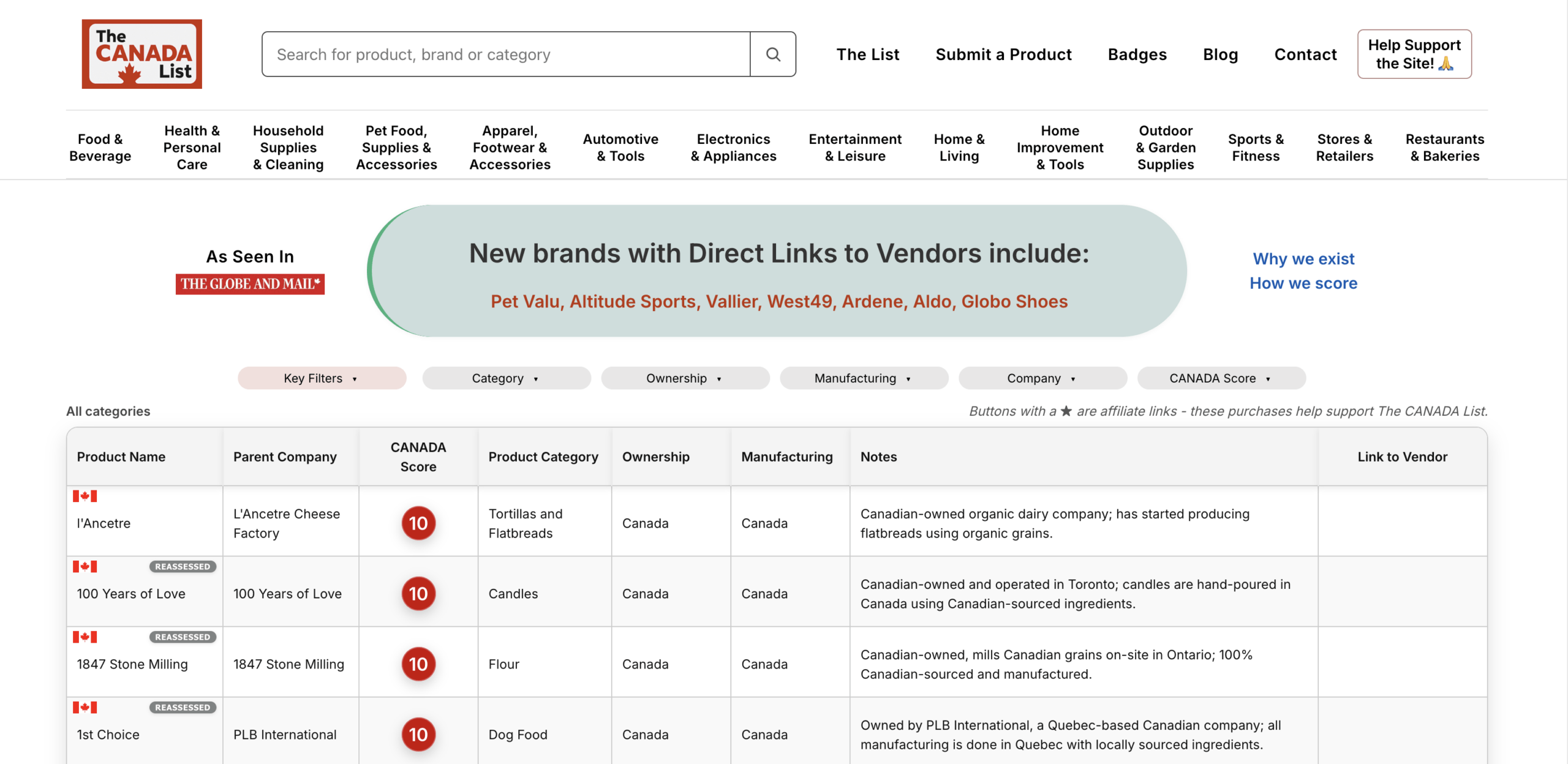
At the centre of the platform is its “Canada Score,” a ranking system that rates products from 1 to 10 based on how much economic value is likely to remain within Canada.
The score considers four main factors:
- Canadian ownership
- Manufacturing location
- Sourcing of materials and ingredients
- Canadian job support
“It’s not an exact science,” Shane said. “But we’re trying to estimate the extent to which money spent on that product stays in the Canadian economy rather than drifting elsewhere.”
Unlike simpler “Made in Canada” labels, Shane says the scoring system attempts to account for the complexities of modern business structures, including franchises, international ownership, and overseas manufacturing.
“It’s nuanced,” he explained. “Some foreign-owned companies still create Canadian jobs and source Canadian ingredients. We try to reflect that fairly.”
New Partnerships and Expanded Listings
The Canada List now receives between 10,000 and 20,000 monthly visitors and currently contains roughly 8,000 products, with plans to expand significantly through partnerships with Canadian retailers including Voilà and Well.ca. The site is working with these retails to upload their entire product catalogs, which is expected to increase the list’s current 8,000 products by about tenfold.
Incentivized Buying
A key feature is the link to vendor column, which is only available to companies that achieve a top-tier Canada Score of 8, 9, or 10. This design philosophy serves a dual purpose: it simplifies the purchase of solid Canadian products and gently encourages foreign or partially Canadian companies to bring manufacturing or operations back to Canada.
User Accounts and Shopping Tools
The next generation of the platform will introduce voluntary user accounts with personalized features. This includes:
- A Favorites list.
- A Shopping list that is sortable by product type or vendor (e.g., all groceries or all products from Canadian Tire).
Users can compile their list and then click over to a Canadian vendor like Voila or Well.ca, simplifying the process of buying local.
Turning Research Into Action
As interest in supporting Canadian businesses continues to grow, The Canada List is positioning itself as more than a database — aiming instead to become a national hub for consumers who want their everyday purchases to strengthen the Canadian economy.
“Our goal is to make Canadian products not only easier to identify, but easier to buy,” Shane said.
For Shane, one of the most rewarding parts of the project has been discovering businesses from across the country that many Canadians have never heard of.
“I’m learning about incredible companies in B.C., the Prairies, and Atlantic Canada,” he said. “That’s been one of the best parts of this whole experience.”